

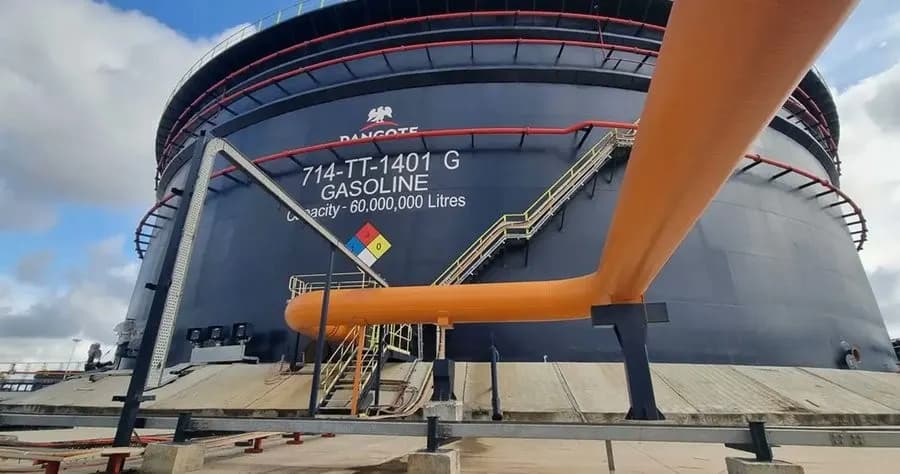
Dangote Refinery has resumed the sale of Premium Motor Spirit (PMS) under a revised distribution structure that limits access to depot owners and selected major marketers, an authoritative industry source has confirmed.
The decision marks a significant shift in downstream supply dynamics and comes amid heightened regulatory engagement aimed at stabilising Nigeria’s petroleum products market.
Controlled Distribution Model Returns
According to the source, the refinery has adopted a model similar to the one implemented in October last year, when a limited number of major marketers were granted access to its products. The strategy is designed to allow depot owners and large marketers to moderate supply flows and influence market pricing more effectively.
While the gantry price remains unchanged at ₦774 per litre, Dangote Refinery will no longer sell directly to independent petroleum marketers (IPMAN members) who typically purchase in smaller volumes. Instead, only depot owners with established storage facilities and approved major marketers will be eligible to lift products.
Approval now follows defined procedures. Buyers must operate functional depot infrastructure or qualify as recognised major marketers before receiving clearance.
The refinery will supply products through coastal vessel shipments, ship-based transactions, and gantry loading for authorised buyers. Depot owners will then distribute products from their facilities and determine ex-depot prices.
Emerging Market Benchmark
Early pricing signals suggest that ₦800 per litre could emerge as the new benchmark.
Within days of the agreement being finalised, depot prices reportedly adjusted upward. Current market indications show Lagos at approximately ₦800 per litre, while Warri, Port Harcourt, and Abuja are trending around ₦820 per litre.
Industry sources say the move aims to reduce volatility and restore confidence across the downstream value chain. Over the past five months, depot operators are estimated to have lost about ₦50 billion due to persistent price fluctuations. Dangote Refinery itself is also said to have absorbed losses exceeding ₦1 trillion during the same period.
The source described the approach as an attempt to create balance within the ecosystem.
“The idea is to ensure stability. Dangote does not want depot businesses to collapse, and it also wants Nigerians to benefit from a more predictable pricing structure. It is about creating a win-win situation,” the source said.
Approved Major Marketers
The major marketers cleared under the new framework include:
Mobil/11 Plc
Total
Matrix
Rainoil
Nipco
Northwest
Ardova
Bovas
Pivot
AA Rano
AYM Shafa
NNPC
MRS
Retail marketers, for now, will access products indirectly through depot channels rather than purchasing directly from the refinery.
Regulatory Backing and Industry Engagement
The development coincides with renewed regulatory engagement led by the Nigerian Midstream and Downstream Petroleum Regulatory Authority (NMDPRA).
The Authority Chief Executive (ACE), Engr. Saidu Mohammed, on Thursday, hosted a high-level meeting with wholesale suppliers of petroleum products at the Authority’s headquarters in Abuja. The engagement brought together key downstream operators to deliberate on supply sufficiency, market stability, pricing transparency, and regulatory compliance in Nigeria’s evolving petroleum market.
Wholesale suppliers commended the Authority for sustaining proactive dialogue with stakeholders and reaffirmed their commitment to compliance and industry best practices.
The meeting underscores NMDPRA’s continued efforts to strengthen transparency, efficiency, and long-term sustainability in Nigeria’s midstream and downstream petroleum sectors.
A Market in Transition
Taken together, Dangote Refinery’s controlled sales model and the regulator’s intensified stakeholder consultations signal a coordinated push toward stabilising the downstream market.
By concentrating supply among larger, capitalised operators while reinforcing oversight, industry players appear to be working toward a more predictable pricing environment after months of turbulence.
Whether the strategy delivers sustained stability remains to be seen, but for now, depot owners have assumed a central role in shaping Nigeria’s petrol pricing structure.